
Blog
The Deepfake CEO: Hacking the Human

In December 2025, an Egyptian public audience was targeted through what appeared to be a legitimate investment advisory broadcast circulating online. Recognizable business figures appeared on screen, delivering confident, data-driven financial guidance.
The messaging was urgent and persuasive: a time-sensitive investment opportunity promised exceptional returns and required immediate participation. The realism of the deepfake production significantly amplified its persuasive power. Professional editing, visual authenticity, and the convincing presence of familiar public personas created a level of credibility that traditional social engineering could not achieve. The objective was clear: create trust at scale and convert public confidence into financial action.
This pattern is not isolated. In early 2024, a multinational firm, Arup, in Hong Kong lost $25 million after a finance employee attended what appeared to be a legitimate executive video conference, later confirmed to be a fully fabricated, multi-party deepfake. [1]
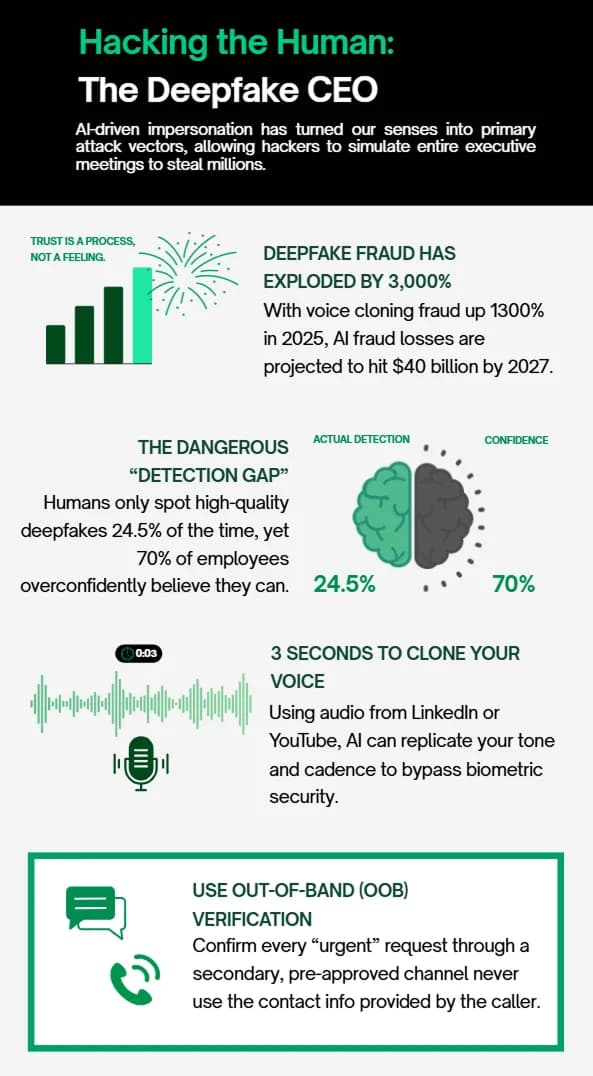
Every person on that call was a deepfake. This incident signals a fundamental collapse of the "seeing is believing" era. For decades, security training taught employees that visual and voice confirmation were the ultimate "out-of-band" verification. Artificial intelligence has turned these human senses into primary attack vectors.
The Anatomy of an AI Impersonation
1. Voice Synthesis (Vishing 2.0) Attackers no longer need hours of audio. Modern AI can clone a voice using just three seconds of clear audio sourced from LinkedIn videos, podcasts, or YouTube. [2]
- The Tooling: Platforms like ElevenLabs and Resemble AI allow attackers to replicate tone, cadence, and even regional accents in minutes.
- The Accuracy: Modern clones can fool not just humans, but some biometric voice-authentication systems.
2. Video Deepfakes By leveraging Generative Adversarial Networks (GANs) and variational autoencoders, attackers can overlay an executive's likeness onto a "base" actor in real-time.
- The Tactic: These are increasingly used in "Town Hall" or "Emergency Meeting" scenarios to bypass the skepticism of lower-level employees.
3. LLM-Driven Rapport Generative AI allows attackers to maintain complex, multi-day dialogues via WhatsApp or email, adapting to the victim's tone and building the necessary rapport to bypass suspicion.
2024–2025: The Threat by the Numbers
The following data highlights the explosive growth of AI-driven impersonation over the last 18 months.
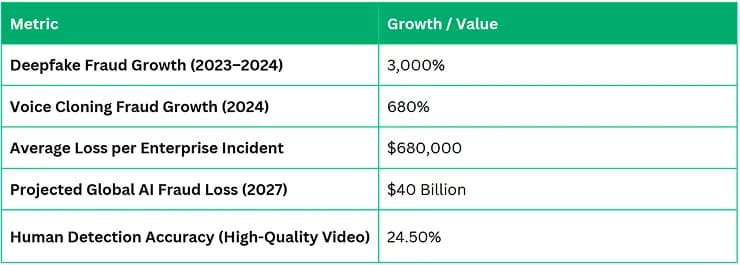
Note: The "Detection Gap" is our greatest vulnerability. While humans can only spot a fake 24.5% of the time, surveys show that over 70% of employees believe they can spot one, leading to dangerous overconfidence.
The Deepfake Attack Chain
- Reconnaissance: Scraping social media (LinkedIn/YouTube) for voice and video samples.
- Synthesis: Training AI models to mirror the target's specific inflection and vocabulary.
- Pretexting: Researching internal company news to create a "High-Pressure/Confidential" scenario.
- The Sting: Executing a live call or video conference to solicit funds or credentials.
- Exfiltration: Moving funds through rapid-fire transactions to offshore accounts.
Case Studies: Lessons from the Front Lines
- Arup Engineering ($25M): Highlighted the danger of "Multiparty Deepfakes" where an entire meeting is fabricated. [1]
- Ferrari (2024): A success story. While the voice was a perfect clone of CEO Benedetto Vigna, the executive on the other end became suspicious of the content and asked a personal verification question. [3]
- Italian Business Elite (2025): Proved that even high-profile political figures (Defense Minister Guido Crosetto) are now part of the "identity library" used to target billionaires like Giorgio Armani. [4]
Defending the Human: Procedural Safeguards
Since technology can no longer be trusted to verify identity, organizations must rely on hardened processes.
Phase 1: Communication Protocols
- Out-of-Band (OOB) Verification: Any request for funds or credentials via video/voice must be confirmed through a secondary, pre-approved channel (e.g., a specific internal chat app).
- The "Call-Back" Rule: Never use the number provided by the caller. Use the directory number stored in the company's internal system.
- Internal Challenge Phrases: Establish "duress words" or non-public verification questions that an AI (relying on public data) could not know.
Phase 2: Technical & Financial Controls
- Dual Authorization: No single individual, regardless of rank, should have the power to authorize transfers above a certain threshold.
- MFA Discipline: Prohibit the resetting of Multi-Factor Authentication (MFA) or passwords via voice/video calls.
Phase 3: Cultural Resilience
- "Permission to Question": Foster a culture where a junior employee feels safe questioning a "CFO" if a request seems unusual.
The human ear and eye are no longer reliable security layers. In 2025, trust must be built on verification systems, not sensory recognition. As attackers move from simple phishing to sophisticated "CEO Clones," our defense must move from simple awareness to rigid, process-driven verification.
Zerosploit Recommendation: Treat every "urgent" video call from leadership as a potential deepfake until verified through a secondary channel.