
Blog
Operationalizing Resilience: The Purple Feedback Loop

The 2025 threat landscape, punctuated by the long-tail effects of MOVEit-style supply chain breaches, has demonstrated that traditional, siloed defensive postures are insufficient. For the modern CISO, the challenge is no longer just "having" security controls, but validating their efficacy against sophisticated, evolving TTPs.
The Purple Feedback Loop serves as a strategic bridge, converting offensive intelligence into defensive hardening. By synchronizing Red Team (Adversarial Emulation) and Blue Team (Detection & Response) operations, organizations can move from a reactive state to a posture of continuous, validated resilience.
The Architecture of Collaboration
Rather than treating offensive and defensive teams as disparate functions, Zerosploit advocates for an integrated ecosystem:
- Red Team: Executes targeted, high-fidelity adversary simulations to expose blind spots in telemetry and control logic.
- Blue Team: Optimizes detection engineering, incident response playbooks, and SIEM/EDR tuning based on real-world data.
- The Synergy: This "Loop" ensures that every identified vulnerability is matched with a verified detection or mitigation, directly improving the organization's Mean Time to Detect (MTTD) and Mean Time to Respond (MTTR).
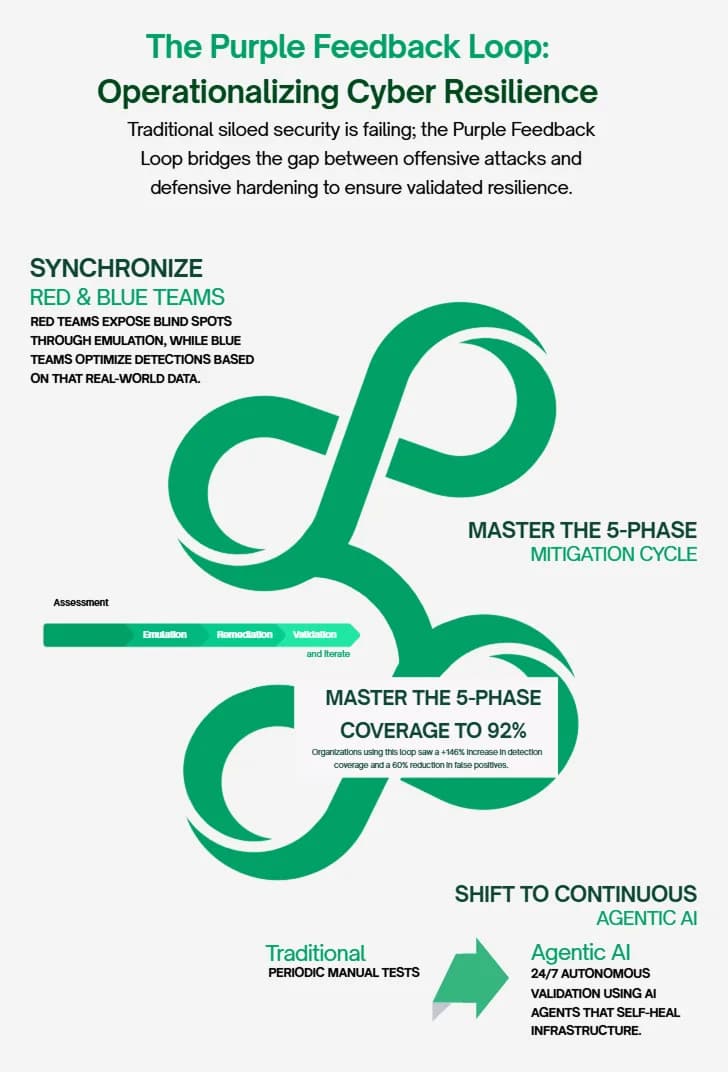
Zerosploit Mitigation Cycle: A Five-Phase Framework
- Strategic Assessment: Identification of critical assets and high-impact attack paths (e.g., identity-based attacks, cloud-native exploits).
- Adversarial Emulation: Execution of TTPs in a controlled environment to stress-test existing security controls.
- Collaborative Remediation: Direct knowledge transfer where offensive findings guide precise patching and configuration hardening.
- Assurance Validation: Immediate re-testing of remediated paths to ensure control effectiveness without operational disruption.
- Continuous Iteration: Feedback is ingested back into the threat model, ensuring defenses evolve at the speed of the adversary.
Case Study: Optimizing the Modern Security Stack
Objective: Validate detection coverage for a Tier-1 financial institution utilizing SIEM and EDR technologies.
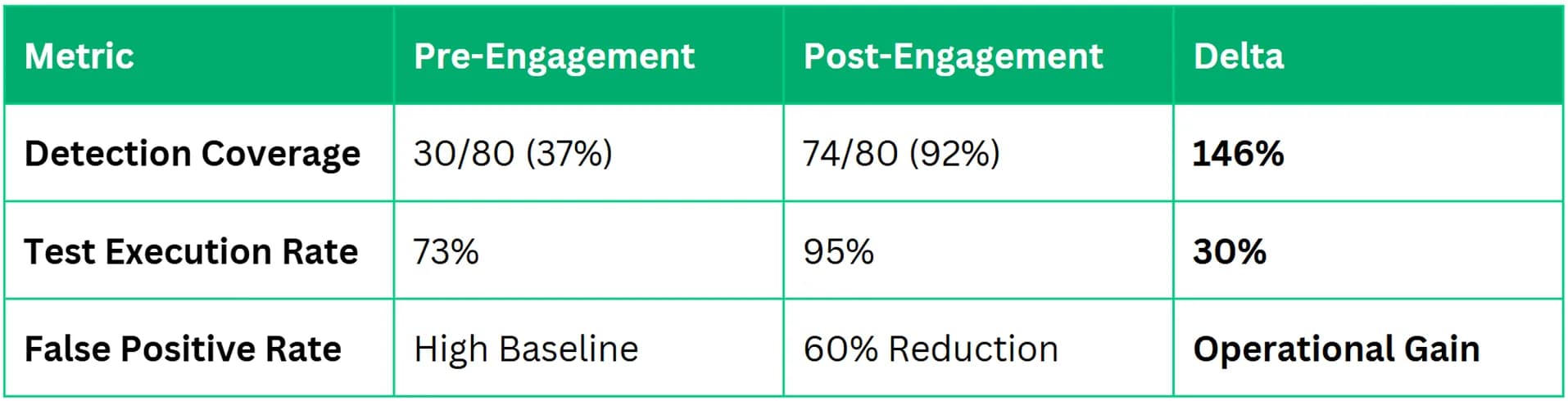
Strategic Outcomes
- Detection Engineering: Developed 25+ custom rules to detect "Living-off-the-Land" (LotL) techniques.
- EDR Optimization: Refined behavioral policies to intercept credential dumping and privilege escalation previously missed by standard configurations.
- Resource Allocation: Significant reduction in SOC "alert fatigue" by tuning out 60% of false positives, allowing analysts to focus on high-fidelity threats.
The Frontier: Agentic AI & Autonomous Validation
To maintain a competitive edge, we are integrating Agentic AI to transition from periodic exercises to Continuous Security Validation (CSV).
- Automated TTP Extraction: Utilizing LLMs to parse unstructured threat intelligence (Dark Web, MITRE updates) into actionable detection logic in seconds.
- The Autonomous Loop: Deploying AI agents that act as a "Continuous Red Team," launching Atomic tests while Blue AI agents monitor SIEM/EDR output. If a gap is detected, the system autonomously suggests and tests new Sigma rules.
- Self-Healing Infrastructure: By late 2026, the goal is a "closed-loop" system where infrastructure adapts and heals in real-time as new threats are identified.
Strategic Comparison: Manual vs. Agentic Purple Teaming
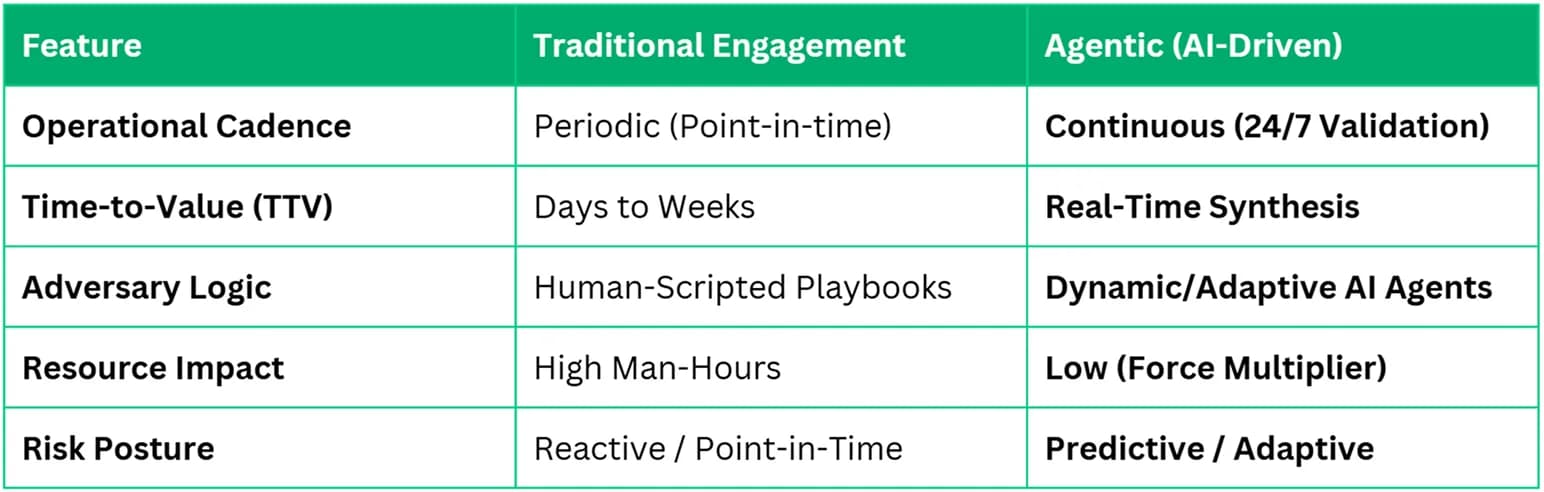
The Future: Agentic & Automated Purple Loops
The industry is pivoting from manual exercises to Autonomous Purple Teaming. By leveraging Agentic AI, the loop moves from quarterly intervals to a 24/7 cycle.
- AI-Driven Threat Intel: Modern SOCs use NLP to parse dark web chatter and vendor blogs, automatically extracting TTPs and converting them into detection logic.
- Self-Healing Defenses: We are seeing the rise of agents that launch "Atomic" tests, analyze the SIEM for misses, and autonomously suggest (or deploy) Sigma rules.
- Looking Ahead: By late 2026, we expect enterprise-grade "self-healing" infrastructure to become the standard for organizations aiming for true cyber resilience.